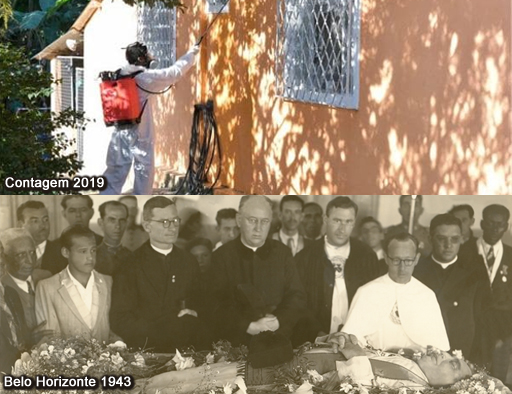
In recent days, a disease has been gaining prominence in the media in Minas Gerais, especially in the capital and metropolitan region. Spotted fever, transmitted by the star tick, has already been responsible for four deaths in Contagem in recent weeks. But this disease has been appearing in the region for some time now.
In 1943, Father Eustáquio carried out his apostolate in the Celeste Império neighborhood (now the Padre Eustáquio neighborhood in Belo Horizonte). The area, considered at the time to be on the outskirts of the Minas Gerais capital, contained many vacant lots, tall grass, and animals of all sizes that inhabited the region. One of these animals was the tick mentioned in Father Venâncio Hullselmans' book, "The Vicar of Poá".
“"Anyone strolling through the "Celeste Império" neighborhood of the Minas Gerais capital, walking along the poorly finished cobblestones of Pará de Minas street towards the "Cristo-Rei" chapel, rejoices in any detour or shortcut that spares them from walking on that uneven road, even if the path leads them through the undergrowth. However, they shouldn't be surprised if, after reaching the little chapel, they feel a rather uncomfortable tickle, because that undergrowth is riddled with ticks, not always harmless ones.". They say that in that neighborhood there is, or was, an outbreak of a type of European tick, once imported by German colonists. It's a dangerous parasite, carrying a fatal disease, typhus.”
Typhus (exanthematic typhus) was the name given to the disease in Brazil at the time. Later, they began using Spotted Fever, the name given by Americans to the same pathology. It is an uncommon disease caused by a bacterium, which is transmitted by the bite of a tick or by the feces of a louse. Symptoms include: fever, nausea, severe headache, muscle aches, and loss of appetite.
And that is exactly what Father Eustáquio began to feel on August 22nd, while he was preaching a retreat to the students of the Sacred Heart College. The symptoms worsened until they became critical on the night of the 29th, when the kind priest awaited the arrival of his Superior, Father Gil, for a farewell, as the doctors gave the ailing priest only a few more hours to live. In the book, Father Venâncio also mentions Father Eustáquio's last moments:
“"At nine o'clock on the 30th, he entered his death throes, but retained the use of his faculties. He joined in the prayers of the dying, insistently asking about his friend. He seemed to refuse to depart from life without having seen his Superior and companion from the first struggles in Brazil, who finally arrived at half past ten, to the relief of all who felt the visible interest of the dying man.".
Upon entering the room, Father Eustace recognized him immediately; he tried to rise, but in vain. “Father Gil, Deo Gratias” (Thanks be to God), was all he managed to say. Then, a convulsive movement of his face, a reaction of his whole body, three deep sighs, and Father Eustace's soul flew to God, to receive the reward for his tireless labor and his great charity.”
Sources: “O Vigário de Poá” by Father Venâncio Hullselmans and the Superintendency for the Control of Endemic Diseases of São Paulo (ucen.sp.gov.br/atuac/maculo.html)
Photos: SSCC Archive / Contagem Daily
 Português do Brasil
  English
  Español