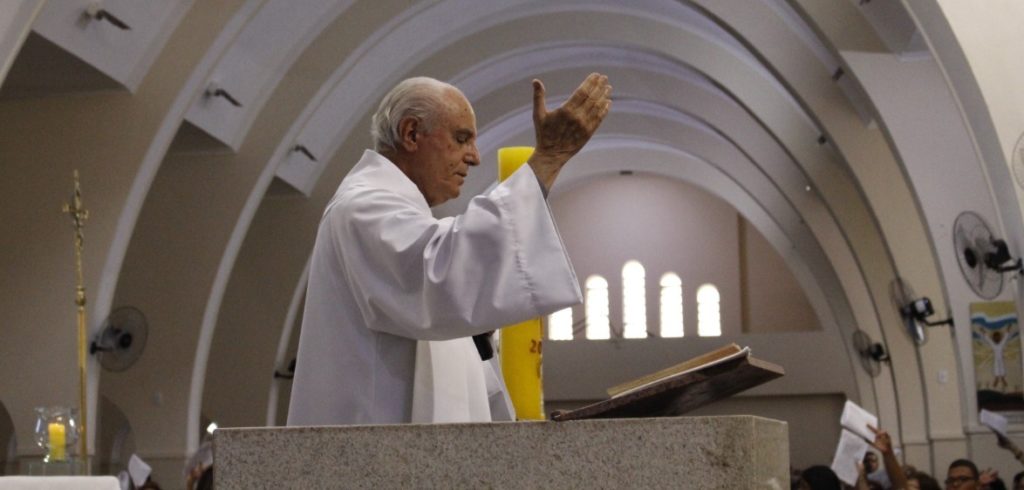
An interview that Father Lúcio Dumont Prado gave to the “Jornal de Opinião” on February 2, 2006, was recovered by the team of the National Secretariat for the Canonization of the Blessed. It is a report he conducted as the fourth vice-postulator, a few months before the Beatification Ceremony of the Dutch priest.
The interview provides details of the life and ministry of the Blessed, but mainly about his Beatification, as well as its importance for the Congregation of the Sacred Hearts and for the Brazilian people.
The elevation of the church to a sanctuary was also one of the topics discussed. At the time, the Health and Peace Sanctuary was still just a dream.
Read the full interview below:
JO – Who was Father Eustáquio?
FATHER LUCIO Father Eustáquio was a man of God, if we were to summarize it in a single sentence. He was a missionary of the Congregation of the Sacred Hearts of Jesus and Mary, a priest whose life was dedicated to the poor, the excluded, the suffering, and the sick, attending to them primarily through a very special gift, a charism that stood out greatly during his life: the gift of healing, the gift of consolation, the gift of touching hearts and converting people. The gift of attracting crowds, the gift of speaking in simple language and filling the auditorium with the educated, the illiterate, those with medical degrees, and those with intermediate knowledge. He gathered all classes of people into a single assembly of listeners, through the power of the Word he proclaimed, through the power of his charism. Simple words and profound knowledge, but without an explanation of theological reasoning; in short, a man of God, a man of prayer, a man with deep communion with God and, as I have just said, intense communion with his brothers and sisters, with a very great sensitivity to the suffering of people. As a religious of the Congregation of the Sacred Hearts, a religious of great fidelity to the entire mission of the Congregation, to the entire experience of the Congregation's charism, great fidelity to his commitments of Religious Life, total obedience, humility and boundless dedication, to the point of offering his own life. We could elaborate much more on Father Eustáquio, but perhaps these are some fundamental traits to define who Father Eustáquio was.
JO — In these turbulent times we live in today, these are examples that should be remembered and followed more often. Did he live exactly what Christ preached?
FATHER LUCIO — Exactly. He summarized his mission and his preaching in two words: “Health and Peace.’ ”Health for your bodies, peace for your souls.“ The Congregation's objective, its mission, is ”to contemplate, live, and proclaim the Merciful Love of God the Father, revealed in Jesus Christ, following the example of Mary, who fully lived this love revealed by Jesus.“ This Congregation is a Congregation focused on a merciful attitude, focused on the human person, and at the same time a Congregation centered on the Eucharist, with the commitment to live the Eucharist and lead people to intensely experience the Eucharistic mystery, with dedication and special affection for the Adoration of Jesus in the Eucharist. Another example, along with Father Eustace, is Father Damien of Molokai, the one who died a leper with the lepers on the Island of Molokai. These are two examples, with different attitudes and different missionary activities, but both entirely dedicated to serving people, the excluded, the suffering, and the sick.
JO — How was the confirmation of the Beatification for the Congregation?
FATHER LUCIO – First of all, he was overjoyed because it was only a short time ago that Father Damien of Molokai, Damien of Veuster, was beatified in 1995. He was overjoyed to have another of his sons, one of our brothers, beatified. Considering and looking more deeply at the Congregation in the following way: the same God who raised up this Congregation in 1800 within the Church, within human society, to reveal God's mercy, to reveal the spirit of family, so that brothers and sisters – because we are a Congregation of brothers and sisters – might experience the family spirit, the Congregation, in the face of the Beatification of both Father Damien and Father Eustace, confirms that this charism is being affirmed by God as a path to perfection in Christian life. In other words, what the Congregation proposes to live, its lifestyle, its life proposal, its common mission, are suitable circumstances for men and women belonging to this Congregation to achieve their human fulfillment, as men and women; their Christian fulfillment, their profound communion with God. It is seen as a confirmation of the charism received.
JO — Father Eustáquio was not born in Brazil, but he spent a large part of his life here. For Brazil, what is the importance of this beatification?
FATHER LUCIO – The great importance lies with the entire Church, with even greater motivation because it is being held here in Brazil. It is important to make evident to everyone how one can achieve human fulfillment through solidarity, through zeal for justice, through fraternal communion, through dedication to those less fortunate, through a simple and profound communion with God, through a simple and profound life of prayer, through a life totally devoted to the Eucharist. In other words, and trying to summarize, being a man, being a woman, being a Christian, and being holy are a path towards Christ, a path in which each step is a step towards Jesus. To be a man, to be a woman, we will achieve this by communing with Christ, being in communion with Christ, the Lord, and in communion with our brothers and sisters of humanity. In communion, in harmony, with all of nature, with all of creation, with the entire Cosmos, with our earth. Therefore, the significance of Father Eustáquio is profound for every human being. And because he lived here in Brazil, he awakens in us, through a natural sense of sympathy, with a greater force, this desire to draw closer to God and also to dedicate ourselves to society and to all people. So I would say, the importance of being a model, an inspiration, and also an intercessor. In general, people seek him out a lot as an intercessor, someone who, together with God, presents our requests because we need to get help. But by beatifying Father Eustáquio, Father Damião, or another saint, man or woman, the Church is presenting a model of life, encouraging Christians to walk according to the Gospel, to live according to the Gospel.
OP — You gave a definition of what it means to be holy…
FATHER LUCIO — In a way. I would say it's an attempt at description, an attempt to explain it a little. In other words, truly holy is he who has truly managed to be fully a man, fully a woman. To be fully a man and a fully a woman, we must achieve our inner harmony. We must live. We must take care of our physical health. We are a whole. We must have a healthy emotional life, a capacity for relationships with people, a capacity to love and be loved. We must integrate within this life the development of our intellectual capacity, of criteria, of judgments, of understanding. We must develop and integrate the capacity for choice, for taking attitudes, for decisions, for interfering in history, for collaborating in the positive direction of history, and also integrate our capacity for communion with the transcendent, with God, which we generally call spiritual life, although it is all a great whole. So, men and women who manage to achieve this personal integration, with others, with nature, and with God, are happy and are holy. Christ revealed who God is, being a man. Each one who manages to be a man, each one who manages to be a woman, fully, is revealing God. Therefore, there is a need for us to be enlivened, enlightened, guided, and also moved by the Spirit of Jesus, the Spirit that led Jesus into the desert, the Spirit that led Jesus to preach the Word, the Spirit that acted in the signs and gestures of Jesus, which we call miracles. This same Spirit, which Jesus gave to humanity at the moment of his death, is the Holy Spirit, who will enable us, men and women, through this integration of our person and through our communion with God and complete integration with all of nature. So, to be holy is to be a man, a woman, to be peaceful, to be a fighter, to be committed to history, to be happy. It is not to follow a path of eccentricity, a strange path different from humanity. It is to be fully man and woman.
OP — Why is the Beatification taking place in Belo Horizonte? Until now, it was only in Rome, wasn't it?
FATHER LUCIO – Before John Paul II, to cite the last few centuries, beatifications were carried out in dioceses, and canonization was done directly by the Holy Father, the Pope. John Paul II, with a missionary intent and a desire to connect with the people, personally desired and celebrated most, or almost all, beatifications and canonizations. Benedict XVI resumed the previous custom whereby beatification is generally celebrated where the candidate for sainthood lived, where the beatification process was carried out, and a pontifical delegate, a delegate of the Pope, goes to this diocese, or the Bishop himself can be a delegate, and performs the beatification ceremony. The Holy Father reserves for himself, but can also delegate, the canonization, which is the final, culminating point of this entire process. It should also be noted that beatification, even though it is a celebration presided over by a pontifical delegate, is a papal act, an act of the responsibility and attribution of the Supreme Pontiff. He is the one who has the ultimate responsibility; The delegate will act and speak on his behalf.
OP — So, based on this principle of missionary work, to be closer to the faithful, the beatification will take place here?
FATHER LUCIO -Also because beatification has more of an indult character, that is, the Church, having recognized the heroic virtues of a candidate for beatification, when declaring him or her blessed, is granting an indult, it is like allowing, mainly in a more restricted region, this public worship of this person. It is permitted for the whole Church, but it mainly targets the places where such a person is known. When canonizing someone, the Church makes a more definitive declaration; it determines that the whole Church recognizes as a saint—let's say in quotation marks "obligatorily"—and recognizes included in the Church calendar, such a person who is canonized. So, beatification has a character of concession, a character of indult, of permission for the whole Church but, mainly, for a specific territory. Canonization has a definitive character, for the whole Church, the universal Church.
OP — You said that the rites of Beatification would be a powerful moment of Evangelization. Could you explain that a little more?
FATHER LUCIO – What we mean by this is that we shouldn't just focus on the outward aspect of having a celebration, which in itself has depth, a profound character, but that people shouldn't only be focusing on the eternal aspect of the celebration, shouldn't only be expecting graces, favors, and miracles, but that the Church should take advantage of this moment to understand what God wants to say to his people, presenting such a person, with such a charism, at this moment in history. What message is God conveying? What invitation is God making for people to have a change of life and a new behavior? A religious congregation, for example, the Congregation of Father Eustace, of the Sacred Hearts, is already interpreting this. God is confirming that this path to holiness, proposed by the Congregation, is a valid path to holiness, because two have already been beatified by following this path, and others will come. It is a way of life, recognized and approved by God. We feel, then, more secure in the Congregation that God has brought forth in the Church, with a determined mission and knowing that dedicating our lives entirely within this perspective of contemplating, living, and proclaiming God's merciful Love, living a life with a family spirit, living a life of intense dedication to our brothers and sisters, especially the excluded, having a life centered on the Eucharist, having a life of true worshipers in spirit and in truth, is a path within which one can truly be a man, one can truly be a woman. One will not be frustrated at the end of the road. One will reach the fullness of one's objective through the strength of God, through the action of the Holy Spirit, through the communion of brothers and sisters, through ecclesial communion, through dedication to society and history in general. Other readings can be done, then; to evangelize, at this moment, is to seek to awaken, illuminate, and make known the figure of Jesus Christ to all people. It is to revive the figure and presence of Christ in history, in the Church, in society, which will result in people turning to Christ. The sense of entering into communion with Christ. They will be stimulated, they will return to help, to be in solidarity. People will feel encouraged to fight for social transformation, for an improvement in society. All this will be awakened, for sure, and the very strength of Father Eustace's charisma will lead people to be stimulated to a new attitude towards life. What is very interesting to observe is that there are countless phenomena of healings, graces received, benefits. Every day we hear more and more people revealing, even to this day, that they have received blessings and graces through Father Eustace. But what is very curious is that in Father Eustace's path, what was most striking was that people changed their lives, they converted. Whoever approached him and talked a little, or made a confession, or received a blessing, changed their lives. An impressive force radiated from Father Eustace. Those who live today and were contemporaries of Father Eustace and knew him, all They unanimously affirm that he was an impressive figure, a peacemaker, someone who inspired people to want to be better. So, this is the proposal we want to make as preparation for the Beatification. This is what we ask of God, that this influence be felt in people's hearts. There is great value in the celebration, but there is a difference in this dimension of stirring the heart, of motivating a new life, of transformation and commitment to history, to society, to the Church, to our brothers and sisters, and to our own hearts, to having a new life. When we spoke of a powerful moment for Evangelization, we understood exactly this.
OP — Dom Walmor spoke about the possibility of elevating the parish to a Sanctuary. If this happens, the space will be too small for so many people.?
FATHER LUCIO "It is certain that there will be a large movement of crowds. With this statement, we do not mean that this is the objective. But, we start from another point of view: already knowing that many people will come from afar, many people motivated because they want to receive a grace from Father Eustáquio, others attracted by his charisma, others by the news; anticipating that there will be an influx of people from all sides, from other cities, from other states, within a certain time, from all over Brazil, this place, which at the moment has a parish church, will be a place of welcome for an attitude of faith and should also be a welcome with an evangelizing purpose. To present Jesus Christ, to present the Church, to present a proposal for life, so there is a much broader spectrum than a parish territory. This place, this temple, as a Sanctuary, must have a structure for administering sacraments, for preaching the Word, for personal guidance, for attending to requests for blessings, which absolutely goes beyond the parish aspect." Therefore, the service will be different because we are attending to a very large crowd, a crowd that will come here as pilgrims, pilgrims who come from afar, with a very determined motivation of faith. No one will make a long journey just to be here. It may happen that some come out of curiosity, but the vast majority are people who will make the sacrifice of a long journey because they consider it important to have a closeness with this figure that God placed here, who is Father Eustáquio. And now, God places him here again, in a much deeper, much broader condition and with a much greater power to touch hearts. That expectation of finding something that brings one closer to God, that expectation will be fulfilled. Everyone will feel deeply touched by God. No one will return from here disappointed.
O'P — The parish already receives many people on "Father Eustáquio's Day" – August 30th.
FATHER LUCIO – On "Father Eustace's Day," we estimate that 15,000 to 20,000 people from many different cities pass through here. And throughout the year, at Mass, we have a percentage—I wouldn't venture to say what—but a good percentage of people who come from many other places, motivated by Father Eustace. They don't abandon their own communities or parishes, but from time to time, they come here. It's that motivation, that feeling of drawing closer to Father Eustace and experiencing the strength of the charism that God placed within humanity through Father Eustace. This is always valid, and the charism doesn't die. The person leaves their body here, and the strength of the charism remains, because it is God who is benefiting his suffering people through this charism, which consists of a special strength from God to encourage, console, awaken hope, and strengthen the people on their journey, in the daily struggle, because God wants his people to be happy.
 Português do Brasil
  English
  Español