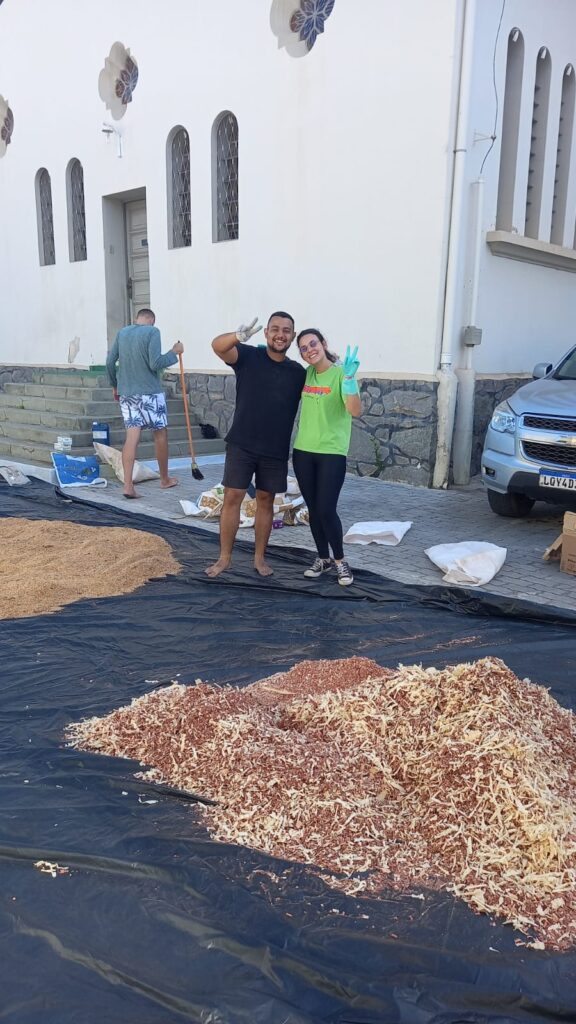
The young people active in the Sanctuary of Health and Peace have been meeting at the church to prepare the material that will be used next Thursday, June 8th, when the Church celebrates Corpus Christi Day.
They are receiving sawdust from the community to dye in various colors to create the designs that will make up the carpets on Corpus Christi Day. So, if you know where we can get sawdust or someone who can donate the material, please contact the Parish Office.
If you are available to help dye the material, please call (31) 3462-6557 and tell us about your willingness to help so that we can count on you.
The origin of the Solemnity of the Body and Blood of Christ dates back to the 13th century. This liturgical solemnity was instituted by Pope Urban IV (1262-1264), through the bull "Transiturus," of August 11, 1264, to be celebrated on the Thursday after the feast of the Holy Trinity, which takes place on the Sunday after Pentecost. Urban IV, before being chosen Pope, was a Canon of Liège (Belgium) and was called James Pantaleon of Troyes, the same one who received the secret of the visions of the nun Juliana of Liège, who requested a feast of the Eucharist in the liturgical calendar.
This solemnity is included in the Church's liturgical calendar to highlight and emphasize the real presence of the Lord Jesus in the consecrated bread and chalice. After the consecration, it becomes: Jesus in the Sacrament. The story goes that a priest named Peter of Prague, very pious and zealous pastorally, lived anguished by doubts about the real presence of Christ in the consecrated bread. He then decided to go on a pilgrimage to the tomb of the Apostles Peter and Paul in Rome to ask for the gift of faith. While passing through Bolsena (Italy), while celebrating Holy Mass, he was again overcome by doubt. At the moment of consecration, the answer came to him in the form of a miracle: The sacred white host transformed into living flesh, dripping blood, staining the corporal (the white cloth on which the consecrated sacred species are placed), the purificator (the cloth used to clean the chalice), and the altar cloth.
At the request of Pope Urban IV, the miraculous objects were taken to Orvieto in a solemn procession. This was the first procession of the Eucharistic corporal. On August 11, 1264, the Pope issued from Orvieto to the Catholic world the precept of a solemn feast in honor of the Body and Blood of the Lord.
**with information from cnbb.org
 Português do Brasil
  English
  Español