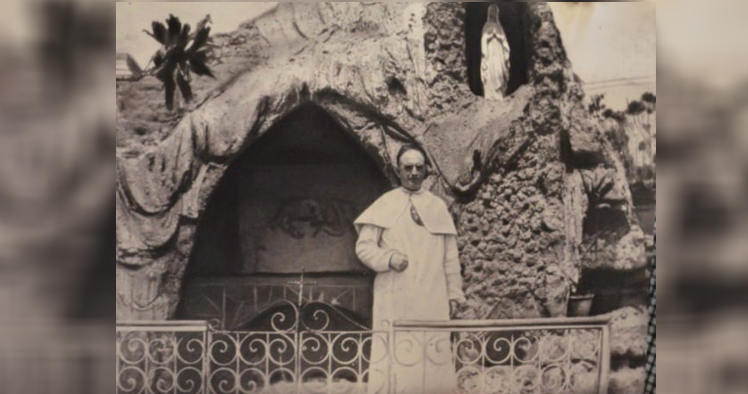
May is the month of Mary, and Blessed Father Eustace always held great devotion to Our Lady. In his personal archives, one can find several texts dedicated to the mother of Jesus.
To mark the month dedicated to Mary, today we will learn about one of these texts written by the Blessed. The material was published in the Bulletin of the Sacred Hearts Parish, in the years 1945 and 1946. Read the following excerpt.
Hail Mary
“"It happened that a holy nun, the founder of the Visitation nuns, was kneeling before an image of Our Lady when two of her companions entered and, after lingering a while in meditation, she said: 'My daughters! Everything we need, we find in Our Lady. When we are in sadness, she is the comforter of the afflicted; when we are in joy, she is the cause of our joy; when we are sick, she is the health of the sick; when we are in sin, she is the refuge of sinners.'".
Indeed, listeners, we find everything in Our Lady, and the titles that the litany attributes to her should give us complete confidence. The title that inspires the most confidence, however, is that of mother!
In truth, Our Lady is my mother, your mother, our beloved mother. Mother of humankind. With the help of this mother, let us meditate on the destiny of humanity, on the end of man. Consider that you are not in this world by chance: some purpose was set for you. This purpose is the glory of God. We were created to know Him, to love Him, to serve Him.
By glorifying God, knowing Him and loving Him, we bear witness to our love. God could have chosen not to create us, but, having created us, He could not have created us for any other purpose.
Disorder in morals may cause us to forget our duties, but it can never change our ultimate purpose. We did not come into the world to amass riches, to acquire honors, to enjoy pleasures; we are in the world to serve God, to love Him, to glorify Him with our love. Kings and vassals, the rich and the poor, the young and the old are not in this world except for this purpose. Even though men are of diverse conditions, even though there is subordination among them, even though some are born to command and others to obey, all came into the world to serve God. Someone may go through life without thinking about why they live, but this truth always remains, with all its consequences.
The end of man! Let us consider the parable of the landowner who planted a vineyard, surrounded it with a wall, and prepared it for planting. He hired workers to labor on it. And when the time came to collect the rent, the owner sent his servant to do it. They killed that servant. He sent another, and once again, they killed him. He sent his own son, thinking that they would at least respect him. They killed him too. This is the story of humanity. God sent the prophets and the patriarchs to teach humanity the obligation to serve God, but, unfortunately, they killed them. He sent his own Son, and they nailed him to a cross.
As for our own story, God has rented the garden of our soul, and we must cultivate it. He comes to collect the fruit of our labor, the salvation of our soul.
Our main concern, our most important question, is: why am I in this world? Why are we in this world? To make money? To seek human honors, pleasures, and joys? No, we are here only to serve God, to see Him eternally afterward.
Saint Bernard always asked himself: Bernard, why did you come into the world? This should be our question as well. We must strive to reach our goal. Who is certain of entering heaven without God's revelation? Do we go to heaven because we are Catholic? Because we observe the commandments? Certainly, with our own efforts, we will never reach our desired end. We must work with God's grace so that we never sin. Reaching heaven is an absolutely personal matter. Our parents, our siblings cannot save our souls. We ourselves must fulfill our duties, observe the commandments, otherwise our eternal damnation will be decided.
Saint Augustine said: "God created you without you, redeemed you without you, but He will not save you without you.".
 Português do Brasil
  English
  Español