Born in the Netherlands with the name Humberto, Father Eustáquio came to Brazil in 1925 to help evangelize the people of this country. He and two other priests, Gil van den Boogaart and Matias van Rooy, arrived in Rio de Janeiro by ship. The arrival of the priests who would found the Congregation of the Sacred Hearts in Brazilian lands is recounted with great humor in the book by Father Venâncio Hullselmans, SSCC:
“"The arrival in Rio was triumphant. Thousands of people were on the docks and hundreds of small, decorated boats came to meet the steamer. Bands played and the people cheered… the heroes of Brazilian football, who were returning on that same steamer from a tournament in Europe.".
Mockingly, his companions said to Father Eustáquio: “Look here; these people think they came to honor their players, but they are mistaken; they came to greet our Congregation.” To which he replied prophetically: “Yes, I never thought that the Congregation of the Sacred Hearts would be received so festively; it must be a harbinger of wonderful things to come.” (The Vicar of Poá, Father Venâncio Hullselmans)
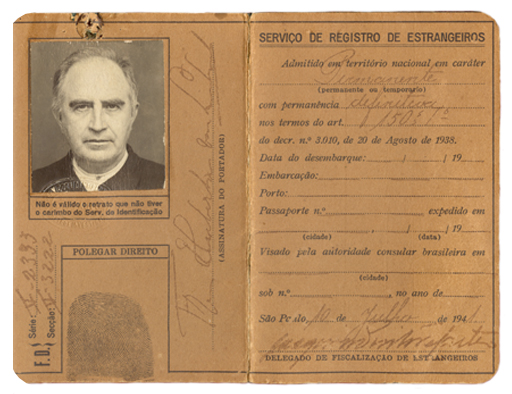
Father Eustáquio worked in the country for 16 years with a provisional permit until 1941, when he obtained the document that granted him permanent residency in Brazil.
Foreigner's Identity Card [photo] (similar in size to a passport) was issued in the capital of São Paulo and granted to the priest on July 10, 1941, with permanent and definitive authorization to remain in Brazil.
The document contains one of the most well-known photos of the priest to this day, and in the signature field, Father Eustáquio's handwriting, but signed with the civil name "Hubertus van Lieshout". He places the title "Frater" before his name because that was how the brothers of the Sacred Hearts addressed each other internally at the time.
Source: SSCC Archive and 'The Vicar of Poá', Fr. Venancio Hullselmans
 Português do Brasil
  English
  Español