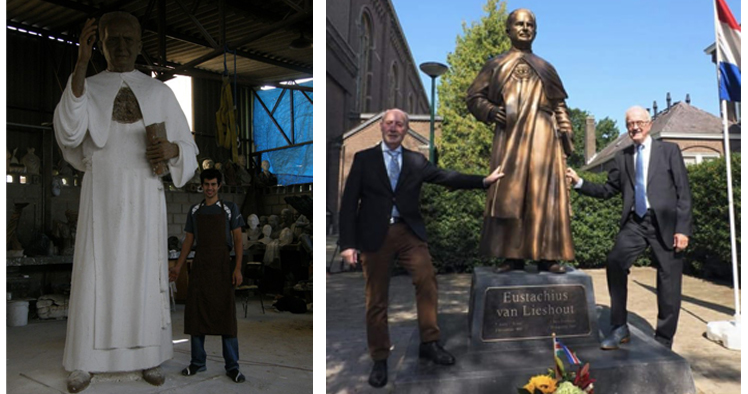
Sculptor Edu Santos distinguished himself by creating the bronze statue of Blessed Father Eustáquio, located outside the Memorial to the Blessed in Belo Horizonte. The work brought recognition and much work to the sculptor, who also became a devotee of Father Eustáquio.
The Padre Eustáquio website team spoke with Edu Santos to learn more about his career and the creative process behind his works.
1 – Edu, tell us a little about your work and your career.
My career started very early; at the age of 5, I already had photos of myself here at my father's foundry. In the past, many artists from Europe came to have their work cast here, and I had the privilege of meeting some of them and aspired to have that kind of work someday. I pursued this through self-study because I never took a sculpture course. I often say that this is one of the best schools there is because artists came to the company and always worked with their pieces and forms here. And I had the privilege of helping some of them and observing their work. This contributed greatly to my training. When I was 16, I took a four-year course in classical drawing, and that helped me a lot in the work I do today. I focus on portraiture, where I explore people's physiognomy extensively and try to immortalize their stories, like the story of Father Eustáquio.
2 – How did the request for the first sculpture of Blessed Father Eustace reach you?
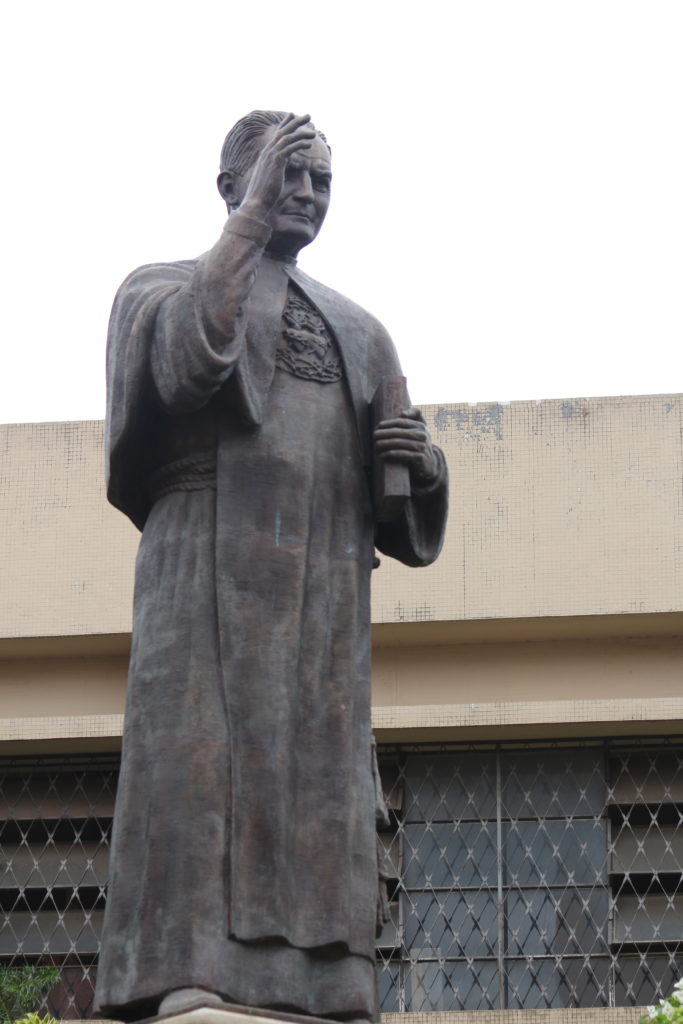
I was already working with sculpture at Fundarte, an artistic foundry, which is one of the largest foundries in Latin America, according to Senai data. And I received a request to prepare a quote (in February 2009) for a three-meter-high statue. I had my first contact with Father Lúcio Dumont Prado (vice-postulator of the Cause at the time) and a translator named Cornelius Ban Requa. They contacted the company, asked for my portfolio, and fortunately I was selected to do this work. Initially, it was a challenge because I was used to working with figurative sculptures, but life-size and smaller. This was my first large work, a three-meter-high statue.
3 – What was the process like for creating this statue?
I was sent several photos of Father Eustáquio, but at the request of the committee, the entire creation process was based on a specific photo. They gave me creative freedom. The model was made in clay and plaster, since I didn't know when the approval date would be from a committee formed by Father Lucio Dumont Prado, Cornelius, Father Eustáquio's nephews Ian and Will van den Boomen, and a foundry worker from Holland who knew all the European casting techniques. After the committee's visit, I received approval, with some alterations. Then the bronze casting process began. The work was cast in four parts, and after casting, it underwent finishing and patina application.
4 – Did this work bring you any kind of recognition?
It was one of the first large-scale works I did that exceeded life-size. I think every artist dreams of having a work of that scale, and I had the privilege of being chosen to do it. It brought me a lot of recognition and marked me deeply. The inauguration celebration was being broadcast online to the Netherlands. It was an unforgettable moment in my life and career. And that same year, I became a member of the Academy of Modern Art in Rome. This work certainly helped me a lot. It was after this work that I was invited to teach in Ouro Preto in a course for professionals who multiply the craft of lost-wax casting, which covers everything from creating the model to casting the works.
5 – How did you receive the news that you were making a sculpture that would go to Europe?
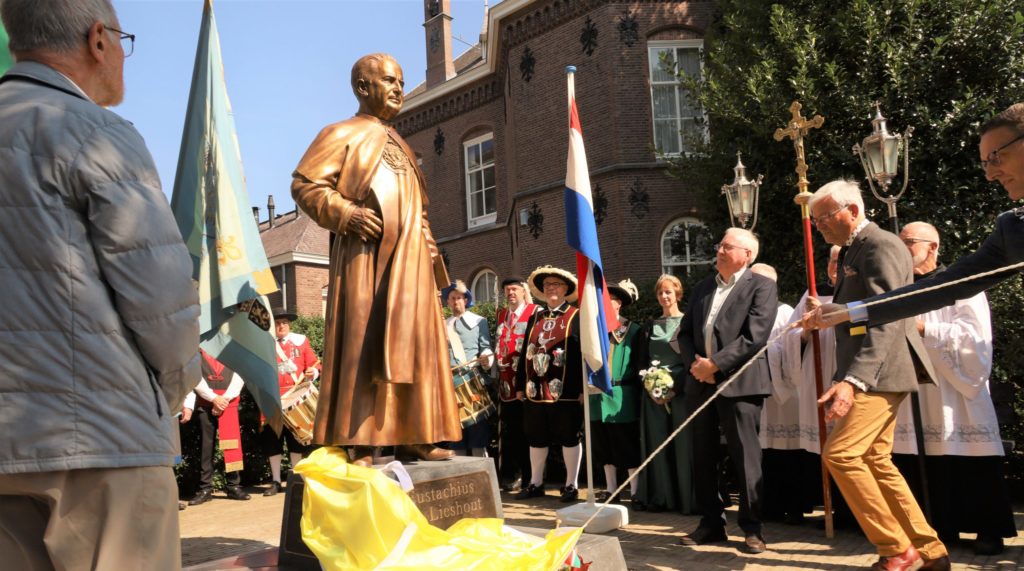
I felt very happy and flattered to be chosen once again to create a sculpture of Father Eustace. At the same time, I was worried about sending a work to Europe, the cradle of civilization and the arts. A sculpture of mine in a public square. It's breathtaking. On May 16, 2020, Will contacted me to get a quote for a two-meter-tall statue of Father Eustace and told me they wanted to place it in a square in Aarle Rixtel, in the Netherlands. He said it would have to go through a district committee for approval. I promptly prepared the quote and at the same time prayed and asked Father Eustace to help me get approved. And Father Eustace granted me this grace. On July 10, Will got back to me saying I had been selected. It was a statue that took a long time to build because of the pandemic. On July 12, 2020, I began the work by selecting some photos with Will, and on the 19th I started the miniature. This miniature is 20 centimeters tall, and it was on this miniature that I studied all the expressions and movements of the sculpture. When I started making the miniature, I asked Father Vinicius for information about the measurements of the Sacred Hearts emblem that Father Eustáquio used on his cassock, and other details. On July 28th, I started making the head of the statue, and by September 4th it was approved. On September 26th, the model was ready and subsequently went through the approval process where we defined the texture that would be used, and thus the work was ready for casting. But the pandemic greatly hampered the casting process. Normally, a work like this takes 30 to 40 days to cast, but the work was only finished much later, at the end of December. After that, we did the bronze coloring, and the work was immediately sent to the Netherlands.
 Português do Brasil
  English
  Español