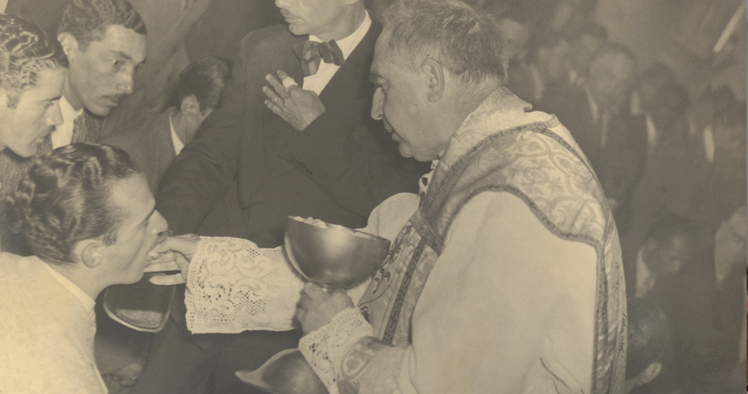
According to the Catechism of the Catholic Church, the Eucharist is the very Body and Blood of Jesus, which He instituted to perpetuate the sacrifice of the cross throughout the ages. And Father Eustáquio, in his writings, presents a text speaking about the importance of communion for Catholics. We invite you to meditate with us on the words of the Blessed. Read the text in its entirety:
“"For the bread of God is that which comes down from heaven and gives life to the world."”
As a priest, I could not fulfill my mission among you if I did not speak to you of this sacred communion, prepared by Christ himself, in which He gives himself, day by day, as food for souls.
Not everyone can approach the table of communion daily, and not everyone who does approach daily does so with sufficient fervor. However, the heavenly banquet is too grand, too holy, for us to remain unnecessarily distant from it, too precious for us to judge our zeal and fervor as sufficient.
Forgive me for failing to deliver on my word with sublimity and fervor. O Jesus, present in the tabernacle, consecrate my words, my language, so that the fire of love may be kindled in the hearts of your faithful.
What keeps men away from the communion table? Is it a lack of love for the One who calls us, or is the food at this banquet not valuable? No, three times no! No one has called their guests with such love, with such insistence. There is no food that can compare to this. I can say with all frankness that it is our lack of attention, our carelessness.
This blinds us, preventing us from discerning the spiritual food, hindering us from clearly seeing the value, care, and love with which it was prepared. This carelessness distances us from meditating on the goodness of the One who prepared the banquet for us. We do not hear the voice of the Lord, who calls us with insistent tenderness.
May our hearts yearn to be nourished with the body and blood of Our Lord, like Saint Imelda, who, as a little child, wept and wept until an invisible hand placed the Bread of Heaven in her mouth. And Saint Stanislaus Kostka, dying, desired Holy Communion and there was no priest who could bring it to him. God, in His infinite goodness, sent Saint Barbara to bring it to him.
Why do our hearts not yearn for Holy Communion? Do we understand what it is? Do we understand Jesus' answer in the Gospel: it is the bread that came down from heaven.
Our eyes see the appearances of earthly food, but they are only a veil that covers Christ. To what, then, can I compare this heavenly Bread? To the manna in the desert? It came down from a great height, but it was common food. The five loaves that multiplied in Jesus' hands were miraculous bread, but earthly bread.
Daniel, in the lions' den, was miraculously fed by God to satisfy his physical needs, but in holy communion, God feeds us in our spiritual needs.
What is this Bread, which, thrown into the fire by mistake, did not consume itself, but shone like the sun within the flames, in the miracle of Amsterdam? What is this Bread, which the pagan Widukind saw enter, like a beautiful little child, into the mouth of Charlemagne when he received communion? What is this Bread, which Saint Tarcisius protected with the loss of his own life? I can say it with the few words of Jacob, in holy scripture: “God is here.”.
Now we understand why this food, of such great value to mankind, should be prized above all things by them. The fruits of holy communion are priceless.
Let us consider the Eucharistic promises of Our Lord:
Whoever eats my flesh and drinks my blood will live in me, and I in him. He will live because of me… He will have eternal life… I will raise him up on the very new day.
It happens that, in the midst of our daily lives, swept away by a current of earthly concerns, we seem to live only for this world. There is a danger of seeking our purpose here on earth, instead of seeking it in heaven. We no longer think of God, whom we must serve, of the Spirit who must make His works fruitful, of the source of life, which is Holy Communion. For these, the word is: He will live in me and I in him.
After Adam's sin, we are not drawn to good, but to evil, even though we know that evil leads to perdition. The human heart, with its feelings of justice and love for its Creator, often surrenders itself to creatures, madly, at the expense of its Creator. And many, only after the fall, recognize their crime and are horrified by their sins and desire a life of friendship with God. Here, I point to fallen man, the tree of life, the supper of angels, the holy table of communion.
From here come all who desire a life more comfortable according to God's laws, and the words of Our Lord will be fulfilled: "Whoever eats this food will live in me. He will have eternal life…"
Sometimes the sky of the soul is so dark, there are no more stars to shine, like on a stormy night when the fisherman is a plaything of the waves. With him, he prays: "Lead me to safe harbor, Lord, lead me to heaven!" Remember, then, the words: "He will have eternal life…"
And to conclude, I quote the words: I will raise him up on the new day. There are no bonds that bind us more to this earth than the bonds of love and blood. No other bond is broken so painfully. Death does it daily. And when bitter tears are shed at the tomb opened too soon, of a loved one, may Holy Communion be your consolation, and hear the voice of those who preceded us, above the tomb: I will raise him up on the new day.
 Português do Brasil
  English
  Español