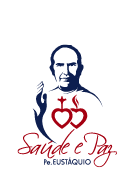

When he arrived in Brazil in 1925, Father Eustáquio began living in Água Suja, now the city of Romaria, in the Triângulo Mineiro region. There he carried out extensive missionary work, building the Sanctuary of Our Lady of the Abbey.
In a statement to the Tribunal for the Cause of Beatification and Canonization of Father Eustáquio, dated August 1964, parishioner Nair Fernandes de Oliveira states:
“"It was Father Eustáquio who began the construction of the new church, using the income obtained from pilgrimages and, calling upon the generosity of the population, he arranged for the stones to be obtained free of charge, for those who would work in their extraction, for transportation in oxcarts, and for the farmers to provide food for the men who worked. This work, called a 'mutirão' (communal work effort), lasted three days and was offered in honor of Our Lady; all this at the initiative of Father Eustáquio. He carried this undertaking forward to the point that when he left Água Suja, the new church was already partially covered."”
Father Eustáquio transformed the community and became much loved, mainly for the work he did with the poor and sick. In a testimony dated May 1965 to the Tribunal of the Cause of Father Eustáquio, Diva Fernandes Hackbarth, another parishioner, highlighted:
“My mother used to turn to Father Eustáquio for any illness that occurred in our house, since there were no medical resources in the area. Father Eustáquio demonstrated knowledge in attending to those cases, and indeed, he was often called upon for illnesses in our home. Once, I was bitten by a dog, and Father Eustáquio came to treat the bite wound; as I had developed a fever, he came to treat it, giving me his blessing at that moment. The fact is that the illness passed… Even back then, graces and cures of illnesses were attributed to Father Eustáquio.”
“Whenever someone was sick, we would let him know, and he would visit, bringing bandages and medicine, and asking if they wanted to receive communion the next day, which he understood, also giving a blessing to the sick. We accompanied him when the visit was to a lady or a young woman. He wasn't afraid of any illness and never failed to attend to anyone who was sick, at any time of day or night. In fact, he had a preference for the poor and sick.” Nair Fernandes de Oliveira told the Court.
”"What impressed me most was his dedication to caring for the sick without the means to do so, sometimes walking long distances. This charity of his impressed me even when I was a child. A noteworthy event was the healing of a brother named Oswaldo, now deceased. Father Eustáquio visited him, gave him his blessing, and administered medicine. He had skin wounds that five doctors couldn't heal, and through Father Eustáquio's intervention, he was cured."” "This was stated by the faithful Anita Fernandes Guimarães to the Court in May 1965.".
The appreciation for the Dutch priest was so great that, upon his transfer from Água Suja, the faithful besieged the rectory and removed the cattle grids in an attempt to prevent Father Eustáquio's departure. Father Gil, who accompanied the Blessed's journey in the city, also gave his testimony to the Tribunal of the Cause of Beatification and Canonization of Father Eustáquio in November 1962:
“Father Eustáquio, who served at the parish church of São Miguel and São Sebastião on Sundays, would return and spend the week in Água Suja, where he taught catechism to children and showed a predilection for the poor and the sick, whom he visited. In this regard, I can relate an event: Father Eustáquio began to attend to a boy who was covered in sores; he himself, as he told me, cleaned those wounds, taking the child with him and administering remedies; the fact is that the boy was cured; his father, who was one of those henchmen who killed for the benefit of contractors who hired enemies, came to thank Father Eustáquio for curing his son and to offer his services free of charge against any adversary Father Eustáquio might have.”
 Português do Brasil
  English
  Español