
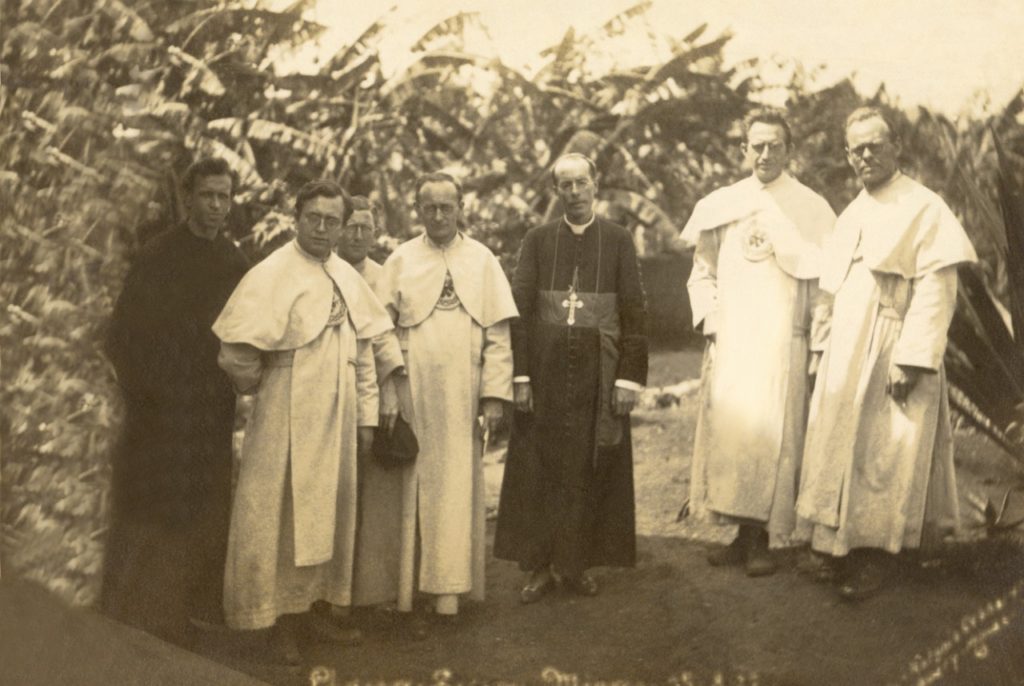
God's mercy is infinite and reaches us at every moment, not because of our merit, but because of the love that the Father has for us, his children.
Father Eustáquio, in many writings, offered meditations on Divine Mercy for us sinners. Read one of these texts below. It was taken from the Bulletin of the Sacred Hearts Parish, dated from the years 1950 to 1952.
Let us seek to reap the most fruitful rewards of meditation on the steps of Divine Mercy.
First Meditation – God loves you. Oh, if God were to abandon us, if He in His just anger were to attack us, like an enraged lion, how many times have we attacked and offended Him, if He, in a word, were to turn away from us, how far we have strayed from Him, yes! Then no one would have enough tears to cry, nor enough laments to lament, because then only the useless recourse, the pathless path of despair and trembling would remain!
Now, God is not like that, nor does He reward us fairly in that way, for the simple reason that He loves us and, therefore, wants to save us, despite everything.
And how can we reciprocate His kindness, brothers? Is it by giving Him forgetfulness, abandonment, offense, and aggression?
Without a doubt, God hates sin and ingratitude in us as the worst evil, and He hates it because it is in His essence that He will hate it as long as God exists, and yet He loves the sinner, desires his repentance, his penance.
He loves us, here's a comparison, like a work of art from His Divine hands, like breath from His own mouth, like the reward of the blood He shed for us.
Absalom will rise up against his reigning father, David, as the sacred pages tell us. The son's crime could not have been greater, more serious, or more egregious.
The king had, and indeed should have, pursued his rebellious son with his army, defeated him, and brought him to reason. But he asked himself, "Should the rebel die?" No, ordered the noble king, "Save my son's life." Thus the king spoke to the commander of his army.
However, Absalom dies and David wins. What happens? The victor despised victory and wept for the vanquished: "Absalom, Absalom, oh, would that I had died in your place!" thus the victor deeply groans.
For such is the state of God's love for us, beloved brothers. Everything justifies and invites Him to take vengeance on us, since His infinite justice cries out: avenge yourselves, you alone have rights. All of heaven also cries out: avenge yourselves. Creation itself protests: avenge yourselves.
So many sins, crimes, and ingratitudes certainly demand vengeance, but the Kind Heart exclaims, each time, in response: souls belong to me, I love them so much, spare their lives.
Yes, my soul, God loves you and, only because, despite everything, He loves you, He still grants you time, He still calls you.
And will I let the deadline pass without replying?
Second Meditation – God calls you. Yes, brothers and sisters, He calls, in various circumstances and in various ways, each and every one of us in particular, and His call, sometimes more insistent, sometimes gentler, makes itself heard or felt on occasions of our lukewarmness or weakness in faith, or in the practice of good, in moments of grave danger, when, so to speak, we have one foot on the edge of the abyss, slipping into temptation, at the very moment of consenting to the danger of sinning.
And the various ways of being called, we have them, sometimes in the voice of conscience, other times in the voice of the confessor, many times in the inspired words of the preacher, and still others in the pages of a good Catholic book, or a morally sound one.
The intensity of the call also has its gradations, varying in strength, taking the names of admonitions, warnings, corrections, threats, and even punishments received from superiors, for He calls us, directly or indirectly, through Himself or through others, by words and examples, not always accepted, not always heeded, due to our inattention, hardness of heart, or gravely risky rebellion.
He pronounced judgment, not in a hundred, nor ten years, nor a year, but within just forty days, Nineveh will perish if it does not repent of its sins, and He had it announced by Jonah, by God's command charged with giving warning to the sinful city.
And what happened? The people heard the prophecy, were frightened, and did penance, from the greatest to the least citizens, from the king to the beggar: God might forgive, so said the members of the Novus Ordo movement, and if He consents to appease His wrath in the face of our reparations, only then will we not perish.
Meanwhile, the prophet, outside and far from the city, in the shade of a tree, awaits the decision of the Almighty regarding the city's ruin.
Meanwhile, the tree withers, and Jonah, grieving, even wishes for death.
"You are so sad," God told him, "because of a tree you did not plant, which grew and withered without any harm on your part. And why should I not spare Nineveh, that great city, with more than twenty thousand people, who do not know their left hand from their right? Through your own mouth I rebuked those who were going astray, and they listened to my voice and repented. And shall I destroy them still?"
Thus God also admonishes my soul, patiently awaiting its return to Him, and will it always wait in vain?
3rd meditation – And God, brothers, meanwhile, waits for us, unlike how men would proceed, who more quickly dismantle a building, or whatever it may be, an achievement, than they create it, because with God it is precisely the opposite, although He creates in an instant, He does not so easily decide to lose or destroy.
Yes, it is remarkable how, in creating, God works swiftly to sanctify a John the Baptist in Jeremiah, to convert a Saul and an Augustine, to give another heart to Magdalene, the sinner, and to Mary of Egypt, to forgive Zacchaeus and Peter, sincere and repentant, and finally, to promise paradise to Dismas.
So, brothers, when it comes to punishing or destroying, it seems as if He is dazzled by His Omnipotence, as if He Himself were interested in fearing and proving it, and that is why He waits, hesitates, and does everything to ensure that nothing comes out of what happened as a necessary and imperative example and lesson, decided by the very rebellion and hardness of men's hearts.
Forced to take up the rod to punish, it sometimes happens that one still has to wait a long time to punish, or to make oneself respected, as if exhausting all the reasons of the stubborn and hard-necked.
When He wanted to devastate the world with a flood, which is no fable, He waited a hundred years, but when He condemned Nineveh, He set a deadline of 40 days. Yet, to subjugate the people of Israel to their deserved and lamented enslavement, He took so long that, in vain, there was time to send several prophets to convert them.
In this way, God shows who He is: first, Mercy, if accepted; then, Justice, if the first is rejected. And so it is that God, who is God, waits for us and endures and suffers our always futile and vain offenses, the fruit of our blindness of spirit and hollow vanity.
But this enduring, suffering, and waiting also has its limit, its measure; it goes so far as to endanger and cast doubt, in the eyes of men, on the power, authority, and sovereignty of God, so to speak, which is most necessary and indispensable for the guarantee of men themselves. And the measure is the limit, the occasion for God to speak and demand proof of good will, because no one can deny Him, first and foremost, that His authority, His sovereignty, His honor, His are the greatest interests, because they are also those of men of good will who hope in the Lord and cannot be indefinitely deceived and sacrificed in their hope, in the rights of their God.
Thus, God waits for us and endures our offenses, to the extent that long-suffering and Divine Mercy seem impossible for men to reach. However, jealous and demanding of His rights, He also has now the moment to claim and enforce them, because He does not sell the guarantee of His authority and the solidity of His rights for mere artificial and conventional appearances, so characteristic of today's world, especially the spheres of the so-called powerful of the day, who forget, however, that all power comes from above, or it is none at all.
 Português do Brasil
  English
  Español