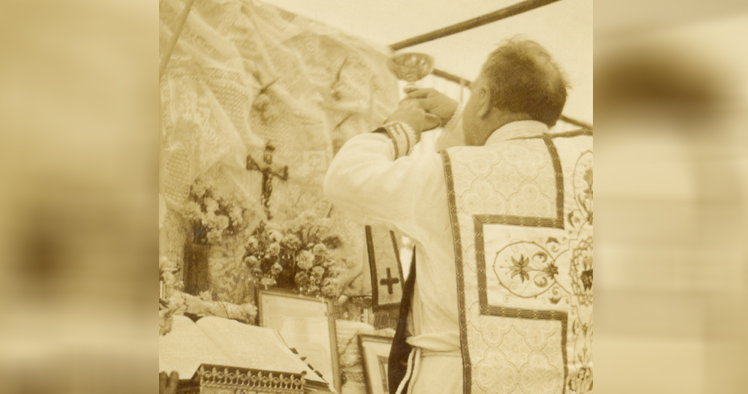
Father Eustáquio, in his writings and also in the practice of his life, showed an ardent love for the Blessed Sacrament of the altar. In several writings he offers reflections on the subject, as is the case in today's text.
The Blessed One presents the Blessed Sacrament as a source of love for humanity; having done everything for us, He emanates the love He feels for His children. Read the full text:
“"God is love, and whoever remains in love remains in God, and God in them."”
Today, I wanted to speak to you about the infinite love that emanates from the Blessed Sacrament of the Altar, the love that exhausts itself in sacrifices, the infinite love that forgets itself, that faces suffering, persecution and outrage, that, instead of thinking of itself, always seeks the happiness of others.
“What more must I do that I have not already done?” says Our Lord. May this meditation inflame our hearts ever more, making them a source of consolation for the Sacred Heart of Jesus, which beats in the Blessed Sacrament of the Altar.
You call a mother's love for her child great. You are right, this love is something magnificent. I see a mother sitting by the bedside of a sick child. The days are long, the nights even longer for the mother who keeps vigil. However tired and exhausted she may feel, she does not leave her child's bedside, and the sick child's hand never seeks, in vain, the mother's hand. This proof of maternal love Jesus gave us on the eve of his death.
Even if a mother were to forget her son, I will never forget you, said Jesus. Despite the offenses He foresaw, despite the dark night of suffering that awaited Him, He instituted the Blessed Sacrament of the altar, through which He could remain, throughout the centuries, in the midst of men who would love and despise Him. “He loved us without end,” says Saint John. And Saint Paul tells us clearly in his letter to the Corinthians: “For I received from the Lord what I also passed on to you: The Lord Jesus, on the night he was betrayed, took bread, and when he had given thanks, he broke it and said, ”Take and eat; this is my body, which is for you; do this in remembrance of me.’” On the night He was betrayed!…
These words weave a crown of roses of love around the Sacred Host! On the very night that death assails Him, He breaks the Bread of Life for us! On the night when no one watches with Him, He chose the Tabernacle to watch over us. On the night He was betrayed with a kiss, He holds us close to His heart. On the night He was chained by the soldiers, He voluntarily surrendered Himself to the prison of the Tabernacle. Jesus sensed the coldness with which He would be treated in the future, how His Church would often be empty because no one would come to adore Him. All this did not make Him give up: “I want to remain with you until the end of the age.”
My brothers and sisters, when I reflected on this great love of Jesus Christ in his tabernacle, and on the other hand, the coldness in the hearts of men towards Jesus, I resolved to become a beggar for Jesus in the Blessed Sacrament. I do not ask for alms of gold or silver, of material goods, but I ask for Love, more love for Jesus in the Host! I beg in churches, in pulpits, in confessionals, in catechism classes, in schools, in the streets, in nursing homes, on trains, I beg priests and nuns and all the People of God! You may say, perhaps, we already love Jesus, but I say: you must love him more, because many do not love him. It is necessary to love him like King Wenceslaus, who left his bed every night for an hour. He greeted his King hidden in the tabernacle, with such a burning heart that the snow melted on his garments and his servants found his warm footprints.
We must love Him like Saint Charles Borromeo, who overflowed with ecstasy when contemplating the Sacred Host. We must love Him like Saint Francis Regis, who, exhausted after his travels in the South of France, knelt on the floor before the closed doors of a church, in adoration of the Blessed Sacrament, throughout the night. I once asked a leper woman, who spent hours and hours at the foot of the Blessed Sacrament, what she did during all that time. “Oh, Father, I don’t know how to read. I pray the prayers my mother taught me and then I repeat them a thousand times or more: Jesus, I love you, but increase my love!” This should also be our prayer. Kneel at the foot of the Tabernacle, together with Mary. Ask her to pray with you, to adore her Divine Son. Our duty to adore Jesus is our duty of gratitude, for what do we possess that we have not received from the hands of God? Jesus, our God, is present in the Blessed Sacrament: “Come to me, all you who are weary and burdened, and I will give you rest.”
Those who love Jesus will not be content with mere adoration. They will also desire to unite with Him in Holy Communion, in which we not only take Jesus in our arms, like old Simeon, but receive Him into our hearts. May Jesus not be a stranger to us! May the words of Saint Augustine not apply to us: "Late have I loved you!"”
(Bulletin of the Sacred Hearts Parish – 09/22/44 and 09/29/46)
 Português do Brasil
  English
  Español