The centenary of the ordination of Blessed Father Eustáquio (1890-1943) was commemorated in Belo Horizonte this Friday (30), at the traditional celebration in honor of the religious man born in the Netherlands who lived for 17 years in Brazil, 12 of which were in Minas.
‘'His motto was health and peace, and that is the path we must follow towards fraternity,' stated the Archbishop of Belo Horizonte and president of the National Conference of Bishops of Brazil (CNBB), Dom Walmor Oliveira de Azevedo, who celebrated the 4 pm mass – in total, there were nine celebrations.
According to the organizers, approximately 25,000 people visited the Health and Peace Sanctuary, also known as the Church of Father Eustáquio, in the neighborhood of the same name, in the Northwest Region of the capital.
From early morning, the faithful arrived at the temple where masses were celebrated every two hours, to commemorate the 76th anniversary of the death of the religious figure who worked in the Alto Paranaíba Region and in Belo Horizonte for a year and four months.
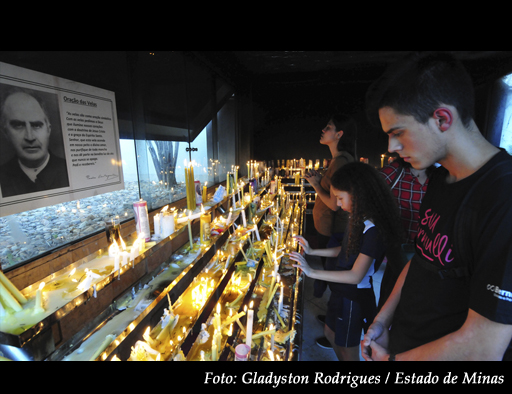
At the memorial that holds the remains of the blessed one, men, women, and children wrote their requests for graces and blessings, lit candles, or simply prayed with their hands on the tombstone.
As he lit a candle, 18-year-old student Daniel Rossi said he was asking for "health, peace, and lots of good things." "And to do well on my exams?" the reporter asked, immediately hearing the reply with a broad smile: "Ah! We always ask for that, right?"“
Accompanied by his grandmother, Maria Aparecida de Freitas Valadares, 65, 16-year-old student Ackel Hermógenes, a resident of the Paquetá neighborhood in the Pampulha region, celebrates his birthday on the day dedicated to the blessed one. "I haven't needed to ask him for anything yet," confessed the teenager.
The grandmother explained that another grandchild was born on August 18th and that she was "sure" Ackel would arrive on August 30th. "And it was exactly as she expected," said Maria Aparecida, who always attends the church and, this time, also brought her 9-month-old grandson Théo with his mother, Andreza de Freitas Valadares. "I had a high-risk pregnancy, I asked God, through the intercession of Father Eustáquio, to help me. So, I always come to give thanks," revealed Andreza.
Professor Tânia Ribeiro, a resident of the Santa Mônica neighborhood in the Pampulha region, also had much to be thankful for. For many years, she had been searching for an apartment to live in the Padre Eustáquio neighborhood.
“One day, as I was leaving a building, I had a thought, as if I heard a voice, that the priest was helping me. It was 'out of nowhere'. I got the apartment and lived in the neighborhood for 15 years.‘
At the memorial, many Catholics prayed before the image of Our Lady of the Abbey of Água Suja, a replica of the one in the church built in 1925 by Father Eustáquio in Romaria, formerly Monte Carmelo, in the Alto Paranaíba Region.
Beatified in a ceremony at the Mineirão stadium in Pampulha on June 15, 2006, Father Eustáquio is in the process of canonization, but to become a saint, the Vatican must recognize a miracle that occurred after that date.
According to the vice-postulator of the cause and pro-rector of the Health and Peace Sanctuary, in the Parish of the Sacred Hearts, Father Vinícius Maciel, there are still no records of miracles, although many graces and blessings have been reported. “What is happening today is the expansion of communities dedicated to the Blessed throughout Brazil and abroad. There is a parish in Guarapari (ES), Esmeraldas (Greater BH), nearby, and churches in Japan and India, due to the spread of the Congregation of the Sacred Hearts.”
According to Father Vinícius, Father Eustáquio was a "merciful man," capable of caring for the suffering, the poor, the sick, and children. "Faith was the fundamental point of his love for his neighbor. The greatest lesson he left behind is that it is possible to combine religion and religiosity with real life today.".
Many people often seek something external and intimate in religion, but Father Eustáquio taught us that religion is part of concrete life, of human suffering, of those in need.”
Source: Estado de Minas Newspaper – Gustavo Werneck
 Português do Brasil
  English
  Español