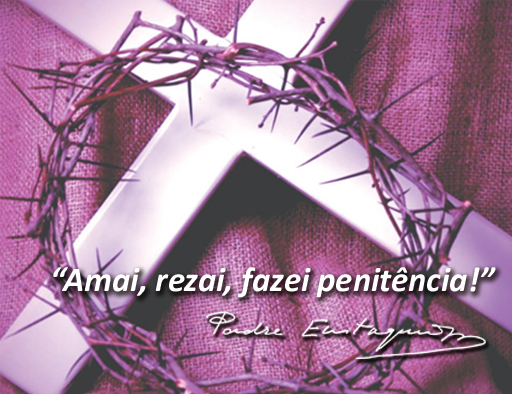
In his writings, Father Eustáquio always brings us a reflection on God's Infinite Mercy towards us, but for this, the Blessed reminds us that we must do our part: 'Love, pray, do penance!'. To help us understand this special time for reflection and conversion, we have selected an article from the Canção Nova Community, which I invite you to read and reflect on with us:
Lent, as we have long known, is a time of conversion. This is a theme that never loses its relevance in Christian life, which is why we want to reflect on it once again. The imposition of ashes, with which the Church begins our preparation for the solemn celebration of the Easter Triduum, cannot be a formal, folkloric gesture, a mere tradition. It must be an expression of a commitment to allow oneself to be molded by the Holy Spirit for personal and communal conversion.
The Old Testament, in addressing conversion, heavily emphasized the cultic aspect: the rejection of pagan worship, the transition from idolatry to the worship of the true God, and submission to His Law, given to the people through Moses. Later, the prophets deepened the theme, not only announcing a more perfect inner covenant, but also insisting on compassion for the vulnerable: orphans, widows, and the poor. Among the Old Testament prophets, we can include the greatest of them all: John the Baptist. He insisted on a change of attitude, on the practice of justice, solidarity, compassion, and meekness as necessary to welcome the Messiah.
Jesus' public ministry begins with a powerful announcement: 'Repent…'. On Ash Wednesday, we still feel the echo of the Lord's voice, who, through the Church, invites us to conversion: 'Repent and believe in the Gospel'. It is in a Christian key that we are called to understand Jesus' strong invitation. For this, I take the parable of the Prodigal Son or the Merciful Father, because in it we find the most significant example of what we Christians should understand by conversion: it is abandoning the false gods that insist on dominating our hearts and going to meet the true God, the Father. Going to meet Him and allowing oneself to be transformed by His love is the source of a new life. Therefore, when Nicodemus sought Jesus out, He explained that it would be necessary to be born again to see the Kingdom of God.
We can affirm: here is the true meaning of conversion: 'being born again'. This is the great wonder that God wants to work in the lives of his beloved. Conversion is the recreation of being, a fact more admirable than the creation of the Universe. It is primarily the work of the Holy Spirit within us, so that with renewed joy we may pronounce: 'Abba'.
It seems to me that Rembrandt's beautiful painting 'The Return of the Prodigal Son' sought to express this reality of conversion as a new birth, when it presents the son held tightly in his father's hands, with the somewhat shapeless silhouette of a human embryo. He is being gestated in the light, in the warmth, in the loving embrace of the Merciful Father. Thus, conversion launches us into a deeper and more intimate relationship with God, whom we do not see, and necessarily with our brothers and sisters, whom we see knocking at our door with hunger, cold, weariness, illness, loneliness, and despair. Only 'new' men and women will feel compassion when they see in faces deformed by misery, the very face of Jesus.
During Lent, the Church seeks to prepare its faithful, through the solemn celebration of the Easter Triduum, for the renewal of our existence in Christ. Lenten practices such as fasting, abstinence, almsgiving, and patience with our neighbor will foster this rebirth. We will be nurtured within the Church, in the community.
In the strength of the new life that will permeate us, we will ardently renew our commitment to serve the Kingdom of God, to humbly and helpfully kneel before our little brothers and sisters. This is the grace we should most aspire to when participating in the celebration of the Easter Triduum.
Source: Canção Nova Community
 Português do Brasil
  English
  Español