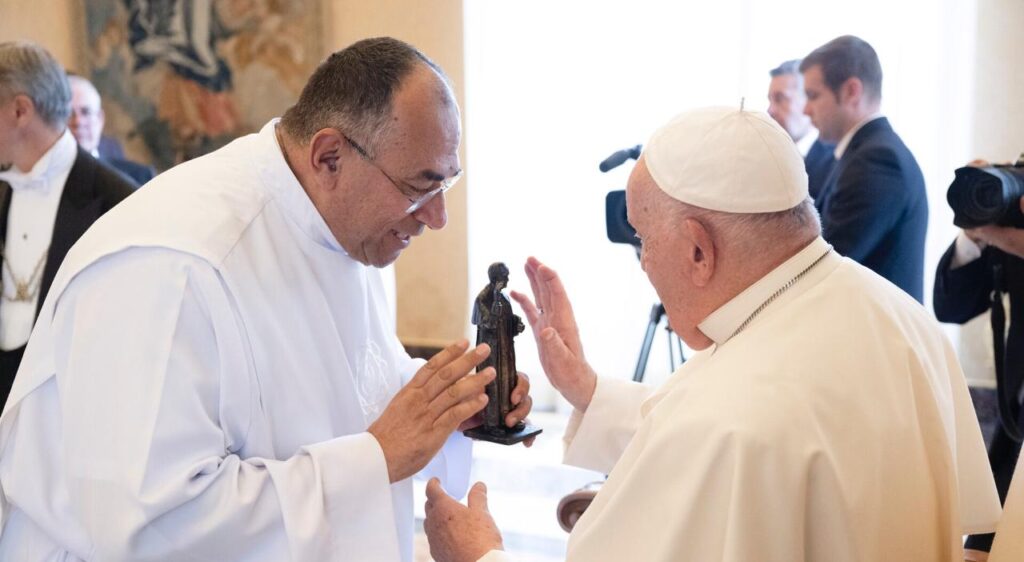
According to the National Conference of Bishops of Brazil – CNBB, the announcement was made, with regret, this Monday morning, directly from the Chapel of the Casa Santa Marta, in the Vatican, by the Camerlengo of the Church, Cardinal Joseph Farrell, with the following words:
“At 7:35 this morning, the Bishop of Rome, Francis, returned to the Father’s house. His entire life was dedicated to the service of the Lord and His Church.”.
He taught us to live the values of the Gospel with fidelity, courage, and universal love, especially in favor of the poorest and most marginalized.
With immense gratitude for his example as a true disciple of the Lord Jesus, we commend the soul of Pope Francis to the infinite merciful love of the Triune God.”
Last message
Yesterday, Sunday, the Pope appeared on the balcony of St. Peter's Basilica for the Urbi et Orbi Easter message, leaving his final message for the Church and the world. The text, read by Monsignor Diego Ravelli, Master of Pontifical Liturgical Celebrations, emphasized Easter as a celebration of life:
“Christ is risen! This announcement encapsulates the entire meaning of our existence, which was not made for death, but for life. Easter is the feast of life! God created us for life and wants humanity to rise again! In His eyes, all lives are precious! From the life of the child in the mother's womb, to that of the elderly or the sick, considered as people to be discarded in an ever-increasing number of countries.”
This message of hope resonates even more strongly today as we witness the countless conflicts occurring daily in different parts of the world. “How much violence we frequently see even within families, directed against women or children! How much contempt is sometimes felt towards the weakest, the marginalized, and migrants!” writes Francis with sorrow, as he expresses his wishes:
“On this day, I would like us to regain hope and trust in others” and “to have hope that peace is possible!” The Holy Father then lists the various countries and regions in conflict, starting with the Holy Land, where this year Catholics and Orthodox Christians celebrate Easter together, expressing concern about the growing climate of antisemitism and defining the humanitarian situation in Gaza as “dramatic and ignoble.”.
In his final message, the Pope also made appeals for peace, which “is not possible without true disarmament.” The Pontiff requested that available resources be used to help the needy, combat hunger, and promote initiatives that foster development. “These are the ‘weapons” of peace: those that build the future, instead of spreading death!” he stated.
“"May the principle of humanity never cease to be the axis of our daily actions. Faced with the cruelty of conflicts that affect defenseless civilians, attack schools, hospitals, and humanitarian workers, we cannot forget that it is not targets that are being hit, but people with souls and dignity." Finally, we hope that in this Jubilee Year, Easter will be an occasion to liberate prisoners of war and political prisoners.
Biography and ecclesial trajectory
He was born in the Argentine capital on December 17, 1936, the son of Piedmontese immigrants: his father Mario worked as an accountant for the railroad; and his mother Regina Sivori took care of the house and the education of their five children.
He graduated as a chemical technician and then chose the path of priesthood, entering the diocesan seminary of Villa Devoto. On March 11, 1958, he entered the novitiate of the Society of Jesus. He completed his humanities studies in Chile and, having returned to Argentina, in 1963 he obtained a degree in philosophy from the San José school in San Miguel. From 1964 to 1965 he was a professor of literature and psychology at the Immaculate Conception school in Santa Fe, and in 1966 he taught these same subjects at the Salvador school in Buenos Aires. From 1967 to 1970 he studied theology, also graduating from the San José school.
On December 13, 1969, he was ordained a priest by Archbishop Ramón José Castellano. From 1970 to 1971, he continued his preparation in Alcalá de Henares, Spain, and on April 22, 1973, he made his perpetual profession in the Jesuits. He returned to Argentina, where he was master of novices at Villa Barilari in San Miguel, professor at the Faculty of Theology, consultant to the province of the Society of Jesus, and also rector of the college.
On July 31, 1973, he was elected provincial of the Jesuits in Argentina, a position he held for six years. Afterwards, he returned to his work in the university field and, from 1980 to 1986, was again rector of the San José school, and also parish priest in San Miguel. In March 1986, he left for Germany, where he completed his doctoral thesis; subsequently, his superiors sent him to the Salvador school in Buenos Aires and later to the Jesuit church in the city of Córdoba, where he served as spiritual director and confessor.
Cardinal Antonio Quarracino invited him to be his close collaborator in Buenos Aires. Thus, on May 20, 1992, John Paul II appointed him titular bishop of Auca and auxiliary bishop of Buenos Aires. On June 27, he received episcopal ordination in the cathedral from the cardinal himself. As his motto, he chose... Miserando atque eligendo and he included the Christogram in his coat of arms. IHS, symbol of the Society of Jesus.
He gave his first interview as bishop to a small parish newspaper, “Estrellita de Belén”. Having been immediately appointed episcopal vicar of the Flores region, on December 21, 1993, he was also entrusted with the task of vicar general of the archdiocese. Therefore, it was no surprise when, on June 3, 1997, he was promoted to coadjutor archbishop of Buenos Aires. Not even nine months later, with the death of Cardinal Quarracino, he succeeded him on February 28, 1998, as archbishop, primate of Argentina, and ordinary for the faithful of the Eastern rite residing in the country and lacking an ordinary of their own rite. He was grand chancellor of the Argentine Catholic University and author of the books Meditations for religious people (1982), Reflections on the apostolic life (1986) and Reflections of Hope (1992).
Three years later, at the Consistory of February 21, 2001, John Paul II created him a cardinal, bestowing upon him the title of Saint Robert Bellarmine. He invited the faithful not to come to Rome to celebrate the purple, but to donate the money from the trip to the poor. With Francis, 41 other cardinals, from 27 countries, joined the College of Cardinals. Among them, two deceased Brazilians, Dom Geraldo Majella Agnelo and Dom Cláudio Hummes. On the day of Pope Francis' election in 2013, Cardinal Cláudio Hummes, emeritus of the Archdiocese of São Paulo, told the then Archbishop of Buenos Aires, Jorge Mario Bergoglio: "Don't forget the poor.". According to Pope Francis himself, this phrase inspired his teachings.
In October 2001, he was appointed adjunct general rapporteur of the tenth ordinary general assembly of the Synod of Bishops, dedicated to the episcopal ministry. This task was entrusted to him at the last minute, replacing Cardinal Edward Michael Egan, Archbishop of New York, who was forced to remain in his homeland because of the terrorist attacks of September 11. At the Synod, he particularly emphasized the "prophetic mission of the bishop," his "being a prophet of justice," his duty to "preach incessantly" the social doctrine of the Church, but also to "express an authentic judgment in matters of faith and morals.".
However, in Latin America his figure was becoming increasingly popular. Nevertheless, he did not lose his sobriety of character, nor his rigorous lifestyle, which came to be described as almost "ascetic." With this spirit, in 2002 he refused the nomination to president of the Argentine Episcopal Conference, but three years later he was elected to that position and then confirmed for another three-year term in 2008. Meanwhile, in April 2005, he participated in the Conclave during which Benedict XVI was elected.
As Archbishop of Buenos Aires—a diocese with over three million inhabitants—he conceived a missionary project centered on communion and evangelization, with four main aims: open and fraternal communities; the active role of a conscious laity; evangelization aimed at every inhabitant of the city; and assistance to the poor and the sick. His objective was to re-evangelize Buenos Aires, “taking into account its inhabitants, its character, and its history.” He invited priests and lay people to work together. In September 2009, he launched a nationwide solidarity campaign in view of the bicentennial of the country's independence: two hundred charitable works to be carried out by 2016.
Aparecida Conference, 2017
And, on a continental level, it fuels strong hopes, following the message of the Aparecida Conference of 2007, even defining it as "the Evangelii nuntiandi” "of Latin America." Still as Mario Bergoglio, he played a significant role in the Conference of Bishops of Latin America and the Caribbean in Aparecida in 2007. He was one of the main figures responsible for drafting the conference's final document.
This text addressed important issues for the Church in Latin America, such as evangelization, poverty, and social justice. His influence and leadership were fundamental in shaping the guidelines that sought a Church closer to the needs of the people and committed to social transformation. This conference also helped consolidate his pastoral vision, which would later be reflected in his papacy.
Until the beginning of the sede vacante, he was a member of the Congregations for Divine Worship and the Discipline of the Sacraments, for the Clergy, for Institutes of Consecrated Life and Societies of Apostolic Life; of the Pontifical Council for the Family, and of the Pontifical Commission for Latin America.
Important documents published by the Pope
The documents of a pope that form part of the magisterium of the Catholic Church include encyclicals, apostolic exhortations, apostolic letters, apostolic constitutions, and discourses. Each of these types of documents has a specific role in transmitting the teaching and doctrine of the Church, contributing to the formation and guidance of the faithful. The main documents of the Pope's magisterium incorporated into the magisterium of the Church were:
1. Evangelii Gaudium (2013) – This is his first apostolic exhortation, which speaks of the joy of the Gospel and the need for a Church that goes forth.
2. Laudato Si' (2015) This encyclical addresses environmental issues and humanity's responsibility to care for creation.
3. Amoris Laetitia (2016) – An apostolic exhortation that deals with love in the family and family pastoral care.
4. Gaudete et Exsultate (2018) This exhortation speaks about the call to holiness in the contemporary world.
5. Fratelli Tutti (2020) – An encyclical that discusses fraternity and social friendship, especially in times of crisis.
- Dilexit us (October 24, 2024)
- Fratelli tutti (October 3, 2020)
- Laudato si' (May 24, 2015)
- Letter Encyclical Lumen fidei (June 29, 2013)
These documents are fundamental to understanding the message and mission of Pope Francis during his pontificate.
Source: CNBB
 Português do Brasil
  English
  Español