
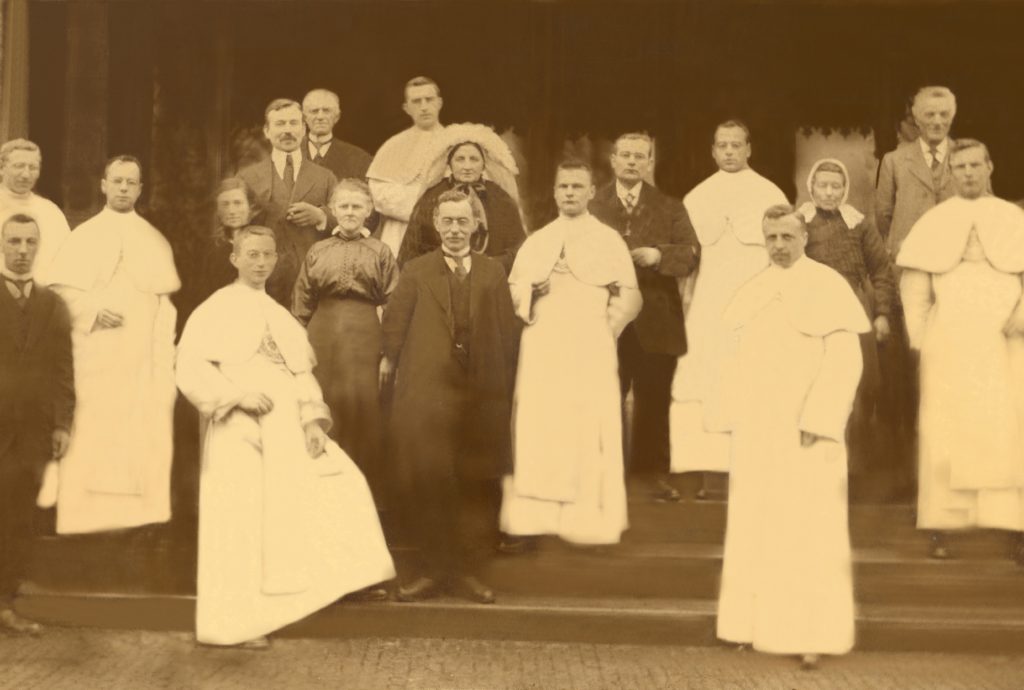
It was in January 1915, less than two years after becoming a novice in the Congregation of the Sacred Hearts, that Eustace made his commitment to religious life. Eustace vowed: Poverty, Obedience, and Chastity, thus making his temporary vows in the Congregation.
Young Eustace entered the Congregation's Minor Seminary at the age of 25, in 1905, and ten years later he made his commitment to God, to himself, and to his brothers. Vows are a kind of commitment that a person makes with the intention of ensuring their dedication. And the preparation time is not short; therefore, much reflection is required on the part of those who want to become a religious. The seminarian enters a completely new reality, where, starting with the vows he temporarily makes, he prepares for perpetual vows. A very special process, where, through the pastoral evaluation of his tutors, he is led to think about his own life from the perspective of the life of Christ, so that the perpetual vows may be a true reflection of his entire life.
Certain of what he wanted, Eustace followed the path taken by his childhood hero: Saint Damien of Molokai, the apostle to those suffering from leprosy. From a young age, the future Father Eustace knew of his adventures and heroism, but in his adolescence, reading the life of Saint Damien captivated him so much that from then on his great dream was to be a missionary like that missionary.
Three years later, in March 1918, Father Eustáquio professed his perpetual vows, thus becoming forever a religious dedicated to the Sacred Hearts of Jesus and Mary and to Perpetual Adoration.
RELIGIOUS LIFE
As soon as a young person enters a Congregation, there is a period of discernment for them to experience and decide whether or not to pursue religious life. On this path, there are two types of vows: temporary and perpetual. These two beautiful realities of entering religious life are the culmination of a whole journey, where the young person will declare, on their own initiative and responsibility, that they wish to follow Christ, the Redeemer. Temporary vows are precisely this anticipation of a definitive desire. Perpetual vows represent a firm decision to embrace Christ's great gesture, evangelizing and giving one's own life with the radicality of the Gospel.
**Written with information from the Pai Eterno website (Father Natalino Martins), retrieved from the portal paieterno.com/noticias
 Português do Brasil
  English
  Español